Low-speed expansion

Using the Lorentz factor, γ, the energy–momentum can be rewritten as E = γmc2 and expanded as a power series:

For speeds much smaller than the speed of light, higher-order terms in this expression get smaller and smaller because v/c is small. For low speeds, all but the first two terms can be ignored:
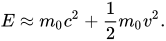
In classical mechanics, both the m0c2 term and the high-speed corrections are ignored. The initial value of the energy is arbitrary, as only the change in energy can be measured, so the m0c2 term is ignored in classical physics. While the higher-order terms become important at higher speeds, the Newtonian equation is a highly accurate low-speed approximation; adding in the third term yields:
- .

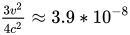
The difference between the two approximations is given by , a number very small for everyday objects. In 2018 NASA announced the Parker Solar Probe was the fastest ever, with a speed of 153,454 miles per hour (68,600 m/s). The difference between the approximations for the Parker Solar Probe in 2018 is , which accounts for an energy correction of four parts per hundred million. The gravitational constant, in contrast, has a standard relative uncertainty of about .



Comments
Post a Comment