History
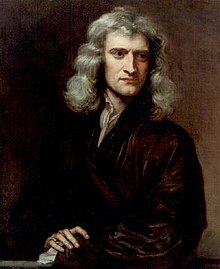
While Einstein was the first to have correctly deduced the mass–energy equivalence formula, he was not the first to have related energy with mass, though nearly all previous authors thought that the energy that contributes to mass comes only from electromagnetic fields. Once discovered, Einstein's formula was initially written in many different notations, and its interpretation and justification was further developed in several steps.
Developments prior to Einsteinedit
Eighteenth century theories on the correlation of mass and energy included Isaac Newton in 1717, who speculated that light particles and matter particles were interconvertible in "Query 30" of the Opticks, where he asks: "Are not the gross bodies and light convertible into one another, and may not bodies receive much of their activity from the particles of light which enter their composition?" Swedish scientist and theologian Emanuel Swedenborg, in his Principia of 1734 theorized that all matter is ultimately composed of dimensionless points of "pure and total motion". He described this motion as being without force, direction or speed, but having the potential for force, direction and speed everywhere within it.
During the nineteenth century there were several speculative attempts to show that mass and energy were proportional in various ether theories. In 1873 Nikolay Umov pointed out a relation between mass and energy for ether in the form of Е = kmc2, where 0.5 ≤ k ≤ 1. The writings of Samuel Tolver Preston, and a 1903 paper by Olinto De Pretto, presented a mass–energy relation. Italian mathematician and math historian Umberto Bartocci observed that there were only three degrees of separation linking De Pretto to Einstein, concluding that Einstein was probably aware of De Pretto's work. Preston and De Pretto, following Le Sage, imagined that the universe was filled with an ether of tiny particles that always move at speed c. Each of these particles has a kinetic energy of mc2 up to a small numerical factor. The nonrelativistic kinetic energy formula did not always include the traditional factor of 1/2, since Leibniz introduced kinetic energy without it, and the 1/2 is largely conventional in prerelativistic physics. By assuming that every particle has a mass that is the sum of the masses of the ether particles, the authors concluded that all matter contains an amount of kinetic energy either given by E = mc2 or 2E = mc2 depending on the convention. A particle ether was usually considered unacceptably speculative science at the time, and since these authors did not formulate relativity, their reasoning is completely different from that of Einstein, who used relativity to change frames.
In 1905, independent of Einstein, Gustave Le Bon speculated that atoms could release large amounts of latent energy, reasoning from an all-encompassing qualitative philosophy of physics.
Electromagnetic massedit
There were many attempts in the 19th and the beginning of the 20th century—like those of J. J. Thomson in 1881, Oliver Heaviside in 188, and George Frederick Charles Searle in 1897, Wilhelm Wien in 1900, Max Abraham in 1902, and Hendrik Antoon Lorentz in 1904—to understand how the mass of a charged object depends on the electrostatic field. This concept was called electromagnetic mass, and was considered as being dependent on velocity and direction as well. Lorentz in 1904 gave the following expressions for longitudinal and transverse electromagnetic mass:
- ,
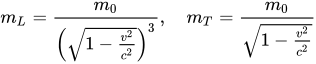
where
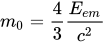
Another way of deriving a type of electromagnetic mass was based on the concept of radiation pressure. In 1900, Henri Poincaré associated electromagnetic radiation energy with a "fictitious fluid" having momentum and mass
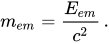
By that, Poincaré tried to save the center of mass theorem in Lorentz's theory, though his treatment led to radiation paradoxes.
Friedrich Hasenöhrl showed in 1904 that electromagnetic cavity radiation contributes the "apparent mass"
to the cavity's mass. He argued that this implies mass dependence on temperature as well.
Einstein: mass–energy equivalenceedit
Einstein did not write the exact formula E = mc2 in his 1905 Annus Mirabilis paper "Does the Inertia of an object Depend Upon Its Energy Content?"; rather, the paper states that if a body gives off the energy L in the form of radiation, its mass diminishes by L/c2.note This formulation relates only a change Δm in mass to a change L in energy without requiring the absolute relationship. The relationship convinced him that mass and energy can be seen as two names for the same underlying, conserved physical quantity. He has stated that the laws of conservation of energy and conservation of mass are "one and the same". Einstein elaborated in a 1946 essay that "the principle of the conservation of mass… proved inadequate in the face of the special theory of relativity. It was therefore merged with the energy conservation principle—just as, about 60 years before, the principle of the conservation of mechanical energy had been combined with the principle of the conservation of heat thermal energy. We might say that the principle of the conservation of energy, having previously swallowed up that of the conservation of heat, now proceeded to swallow that of the conservation of mass—and holds the field alone."
Mass–velocity relationshipedit
In developing special relativity, Einstein found that the kinetic energy of a moving body is
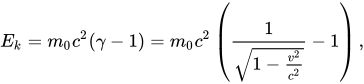
with v the velocity, m0 the rest mass, and γ the Lorentz factor.
He included the second term on the right to make sure that for small velocities the energy would be the same as in classical mechanics, thus satisfying the correspondence principle:
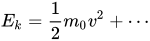
Without this second term, there would be an additional contribution in the energy when the particle is not moving.
Einsteins's view on massedit
Einstein, following Hendrik Lorentz and Max Abraham, used velocity- and direction-dependent mass concepts in his 1905 electrodynamics paper and in another paper in 1906. In Einstein's first 1905 paper on E = mc2, he treated m as what would now be called the rest mass, and it has been noted that in his later years he did not like the idea of "relativistic mass".
In older physics terminology, relativistic energy is used in lieu of relativistic mass and the term "mass" is reserved for the rest mass. Historically, there has been considerable debate over the use of the concept of "relativistic mass" and the connection of "mass" in relativity to "mass" in Newtonian dynamics. One view is that only rest mass is a viable concept and is a property of the particle; while relativistic mass is a conglomeration of particle properties and properties of spacetime. Another view, attributed to Norwegian physicist Kjell Vøyenli, is that the Newtonian concept of mass as a particle property and the relativistic concept of mass have to be viewed as embedded in their own theories and as having no precise connection.
Einstein's 1905 derivationedit
Already in his relativity paper "On the electrodynamics of moving bodies", Einstein derived the correct expression for the kinetic energy of particles:
- .
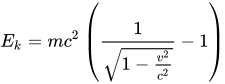
Now the question remained open as to which formulation applies to bodies at rest. This was tackled by Einstein in his paper "Does the inertia of a body depend upon its energy content?", one of his Annus Mirabilis papers. Here, Einstein used V to represent the speed of light in a vacuum and L to represent the energy lost by a body in the form of radiation. Consequently, the equation E = mc2 was not originally written as a formula but as a sentence in German saying that "if a body gives off the energy L in the form of radiation, its mass diminishes by L/V2." A remark placed above it informed that the equation was approximated by neglecting "magnitudes of fourth and higher orders" of a series expansion.note Einstein used a body emitting two light pulses in opposite directions, having energies of E0 before and E1 after the emission as seen in its rest frame. As seen from a moving frame, this becomes H0 and H1. Einstein obtained, in modern notation:
- .
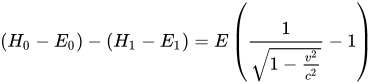
He then argued that H − E can only differ from the kinetic energy K by an additive constant, which gives
- .
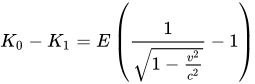
Neglecting effects higher than third order in v/c after a Taylor series expansion of the right side of this yields:
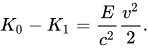
Einstein concluded that the emission reduces the body's mass by E/c2, and that the mass of a body is a measure of its energy content.
The correctness of Einstein's 1905 derivation of E = mc2 was criticized by Max Planck in 1907, who argued that it is only valid to first approximation. Another criticism was formulated by Herbert Ives in 1952 and Max Jammer in 1961, asserting that Einstein's derivation is based on begging the question. Other scholars such as John Stachel and Roberto Torretti, have argued that Ives' criticism was wrong, and that Einstein's derivation was correct. Hans Ohanian, in 2008, agreed with Stachel/Torretti's criticism of Ives, though he argued that Einstein's derivation was wrong for other reasons.
Relativistic center-of-mass theorem of 1906edit
Like Poincaré, Einstein concluded in 1906 that the inertia of electromagnetic energy is a necessary condition for the center-of-mass theorem to hold. On this occasion, Einstein referred to Poincaré's 1900 paper and wrote: "Although the merely formal considerations, which we will need for the proof, are already mostly contained in a work by H. Poincaré2, for the sake of clarity I will not rely on that work." In Einstein's more physical, as opposed to formal or mathematical, point of view, there was no need for fictitious masses. He could avoid the perpetual motion problem because, on the basis of the mass–energy equivalence, he could show that the transport of inertia that accompanies the emission and absorption of radiation solves the problem. Poincaré's rejection of the principle of action–reaction can be avoided through Einstein's E = mc2, because mass conservation appears as a special case of the energy conservation law.
Further developmentsedit
There were several further developments in the first decade of the twentieth century. In May 1907, Einstein explained that the expression for energy ε of a moving mass point assumes the simplest form when its expression for the state of rest is chosen to be ε0 = μV2 (where μ is the mass), which is in agreement with the "principle of the equivalence of mass and energy". In addition, Einstein used the formula μ = E0/V2, with E0 being the energy of a system of mass points, to describe the energy and mass increase of that system when the velocity of the differently moving mass points is increased. Max Planck rewrote Einstein's mass–energy relationship as M = E0 + pV0/c2 in June 1907, where p is the pressure and V0 the volume to express the relation between mass, its latent energy, and thermodynamic energy within the body. Subsequently, in October 1907, this was rewritten as M0 = E0/c2 and given a quantum interpretation by Johannes Stark, who assumed its validity and correctness. In December 1907, Einstein expressed the equivalence in the form M = μ + E0/c2 and concluded: "A mass μ is equivalent, as regards inertia, to a quantity of energy μc2. … It appears far more natural to consider every inertial mass as a store of energy." Gilbert N. Lewis and Richard C. Tolman used two variations of the formula in 1909: m = E/c2 and m0 = E0/c2, with E being the relativistic energy (the energy of an object when the object is moving), E0 is the rest energy (the energy when not moving), m is the relativistic mass (the rest mass and the extra mass gained when moving), and m0 is the rest mass. The same relations in different notation were used by Hendrik Lorentz in 1913 and 1914, though he placed the energy on the left-hand side: ε = Mc2 and ε0 = mc2, with ε being the total energy (rest energy plus kinetic energy) of a moving material point, ε0 its rest energy, M the relativistic mass, and m the invariant mass.
In 1911, Max von Laue gave a more comprehensive proof of M0 = E0/c2 from the stress–energy tensor, which was later generalized by Felix Klein in 1918.
Einstein returned to the topic once again after World War II and this time he wrote E = mc2 in the title of his article intended as an explanation for a general reader by analogy.
Alternative versionedit
An alternative version of Einstein's thought experiment was proposed by Fritz Rohrlich in 1990, who based his reasoning on the Doppler effect. Like Einstein, he considered a body at rest with mass M. If the body is examined in a frame moving with nonrelativistic velocity v, it is no longer at rest and in the moving frame it has momentum P = Mv. Then he supposed the body emits two pulses of light to the left and to the right, each carrying an equal amount of energy E/2. In its rest frame, the object remains at rest after the emission since the two beams are equal in strength and carry opposite momentum. However, if the same process is considered in a frame that moves with velocity v to the left, the pulse moving to the left is redshifted, while the pulse moving to the right is blue shifted. The blue light carries more momentum than the red light, so that the momentum of the light in the moving frame is not balanced: the light is carrying some net momentum to the right. The object has not changed its velocity before or after the emission. Yet in this frame it has lost some right-momentum to the light. The only way it could have lost momentum is by losing mass. This also solves Poincaré's radiation paradox. The velocity is small, so the right-moving light is blueshifted by an amount equal to the nonrelativistic Doppler shift factor 1 − v/c. The momentum of the light is its energy divided by c, and it is increased by a factor of v/c. So the right-moving light is carrying an extra momentum ΔP given by:

The left-moving light carries a little less momentum, by the same amount ΔP. So the total right-momentum in both light pulses is twice ΔP. This is the right-momentum that the object lost.
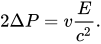
The momentum of the object in the moving frame after the emission is reduced to this amount:

So the change in the object's mass is equal to the total energy lost divided by c2. Since any emission of energy can be carried out by a two-step process, where first the energy is emitted as light and then the light is converted to some other form of energy, any emission of energy is accompanied by a loss of mass. Similarly, by considering absorption, a gain in energy is accompanied by a gain in mass.
Radioactivity and nuclear energyedit
It was quickly noted after the discovery of radioactivity in 1897, that the total energy due to radioactive processes is about one million times greater than that involved in any known molecular change, raising the question of where the energy comes from. After eliminating the idea of absorption and emission of some sort of Lesagian ether particles, the existence of a huge amount of latent energy, stored within matter, was proposed by Ernest Rutherford and Frederick Soddy in 1903. Rutherford also suggested that this internal energy is stored within normal matter as well. He went on to speculate in 1904: "If it were ever found possible to control at will the rate of disintegration of the radio-elements, an enormous amount of energy could be obtained from a small quantity of matter."
Einstein's equation does not explain the large energies released in radioactive decay, but can be used to quantify it. The theoretical explanation for radioactive decay is given by the nuclear forces responsible for holding atoms together, though these forces were still unknown in 1905. The enormous energy released from radioactive decay had previously been measured by Rutherford and was much more easily measured than the small change in the gross mass of materials as a result. Einstein's equation, by theory, can give these energies by measuring mass differences before and after reactions, but in practice, these mass differences in 1905 were still too small to be measured in bulk. Prior to this, the ease of measuring radioactive decay energies with a calorimeter was thought possibly likely to allow measurement of changes in mass difference, as a check on Einstein's equation itself. Einstein mentions in his 1905 paper that mass–energy equivalence might perhaps be tested with radioactive decay, which was known by then to release enough energy to possibly be "weighed," when missing from the system. However, radioactivity seemed to proceed at its own unalterable pace, and even when simple nuclear reactions became possible using proton bombardment, the idea that these great amounts of usable energy could be liberated at will with any practicality, proved difficult to substantiate. Rutherford was reported in 1933 to have declared that this energy could not be exploited efficiently: "Anyone who expects a source of power from the transformation of the atom is talking moonshine." This outlook changed dramatically in 1932 with the discovery of the neutron and its mass, allowing mass differences for single nuclides and their reactions to be calculated directly, and compared with the sum of masses for the particles that made up their composition. In 1933, the energy released from the reaction of lithium-7 plus protons giving rise to 2 alpha particles, allowed Einstein's equation to be tested to an error of ±0.5%. However, scientists still did not see such reactions as a practical source of power, due to the energy cost of accelerating reaction particles. After the very public demonstration of huge energies released from nuclear fission after the atomic bombings of Hiroshima and Nagasaki in 1945, the equation E = mc2 became directly linked in the public eye with the power and peril of nuclear weapons. The equation was featured as early as page 2 of the Smyth Report, the official 1945 release by the US government on the development of the atomic bomb, and by 1946 the equation was linked closely enough with Einstein's work that the cover of Time magazine prominently featured a picture of Einstein next to an image of a mushroom cloud emblazoned with the equation. Einstein himself had only a minor role in the Manhattan Project: he had cosigned a letter to the U.S. president in 1939 urging funding for research into atomic energy, warning that an atomic bomb was theoretically possible. The letter persuaded Roosevelt to devote a significant portion of the wartime budget to atomic research. Without a security clearance, Einstein's only scientific contribution was an analysis of an isotope separation method in theoretical terms. It was inconsequential, on account of Einstein not being given sufficient information to fully work on the problem.
While E = mc2 is useful for understanding the amount of energy potentially released in a fission reaction, it was not strictly necessary to develop the weapon, once the fission process was known, and its energy measured at 200 MeV (which was directly possible, using a quantitative Geiger counter, at that time). The physicist and Manhattan Project participant Robert Serber noted that somehow "the popular notion took hold long ago that Einstein's theory of relativity, in particular his famous equation E = mc2, plays some essential role in the theory of fission. Albert Einstein had a part in alerting the United States government to the possibility of building an atomic bomb, but his theory of relativity is not required in discussing fission. The theory of fission is what physicists call a non-relativistic theory, meaning that relativistic effects are too small to affect the dynamics of the fission process significantly."note There are other views on the equation's importance to nuclear reactions. In late 1938, Lise Meitner and Otto Robert Frisch—while on a winter walk during which they solved the meaning of Hahn's experimental results and introduced the idea that would be called atomic fission—directly used Einstein's equation to help them understand the quantitative energetics of the reaction that overcame the "surface tension-like" forces that hold the nucleus together, and allowed the fission fragments to separate to a configuration from which their charges could force them into an energetic fission. To do this, they used packing fraction, or nuclear binding energy values for elements. These, together with use of E = mc2 allowed them to realize on the spot that the basic fission process was energetically possible.note


Comments
Post a Comment